Monday, June 14, 2010
Abuse Recovery Tip for the Day
Start an emotions log. Note when you have intense or disruptive emotions. Note where you are, who you're with, what you are doing, what you were thinking, how you acted on or wanted to act on those emotions.


Thursday, June 10, 2010
Healing Levity
 I want to start out by saying that there is absolutely NOTHING funny about abuse. NOTHING! The damage is extensive and long term. The scars are massive. The pain is unimaginable.
That being said, there is a place for humor and levity in the abuse recovery process. If you put yourself in the shoes (or more accurately sandals) of Christ, you see his sense of humor revealed again and again. Think about Mary and Martha. I can see him grinning to himself. Think about the multitude of times when he shook his head and pretty much asked his disciples how much longer he had to put up with them. The people he surrounded himself with, the environment he taught in, and the stories he told are filled with real-life joy and humor.
It's important to point out that humor and levity are not the same as cynical and snarky. Rather, they are lenses through which you recognize the truly funny moments in life. And there are - after all - some very funny moments in life – everyone’s life, including yours.
Many abuse survivors are notorious for being pessimists. For believing that not only is the glass half empty, but it's probably got a crack in it somewhere and will be bone dry in an hour. On the other side of that continuum, abuse survivors are also notorious for hiding behind humor as a way to never deal with the deep throbbing places in their souls torn by abuse and dysfunction.
And yes - for those of you who have been reading my articles for awhile - this, too, is all about balance. It's about living somewhere between Eeyore and Tigger (Winnie the Pooh Reference written by A.A. Milne in 1926). It's about recognizing the obvious - that yes, there is some really bad stuff going on, but being determined to find joy. To find silly, ridiculous hilarity. To intentionally look for laughter. To recognize that if you dwell on nothing but the wretched horrors that saturate television and the internet and the newspapers, all of your energy you might have to spend on living in a healthy way will be depleted - consumed by tunnel vision for the awful, rather than the panorama which unfolds when all of life is included.
Humor doesn't come at the expense of others. It doesn't come through denial or minimization. It comes through intentional sight. Intentional listening. Intentional touch. It's a search for the ironic and celebrating what you discover. Nowhere is this more important than with yourself. To take yourself a bit less serious - not in a self-deprecating way, not to belittle or devalue - but to just lighten up a bit. To laugh at your quirks and not feel threatened when others laugh at them, too. To embrace your wonderful, unique, flaws and decorate them with glow-in-the-dark paint (figuratively speaking . . . or maybe not).
There is a Scripture in the Hebrew Bible that states: "A cheerful heart is good medicine, but a crushed spirit dries up the bones." (Proverbs 17:22). Becoming healthier involves cultivating a balanced relationship with the difficulties of living in a flawed world and the hilarity of living in a flawed world. It is, indeed, good medicine and good for you. Children and animals are good places to begin noticing this good medicine. Expand outward from there.
Thursday, June 3, 2010
Collateral Damage

Collateral damage is damage that is incidental to the intended outcome.
To point to your abuse and pin all the issues and damage you face on that one factor would be simplistic - at least for most abuse survivors. Abuse occurs in a context, and sometimes that "context" can be just as damaging as the abuse.
For example, I know a man who grew up in a pastor's home. His father was very harsh, demanding, unforgiving of any mistakes, and emotionally unavailable. His mother was terrified to express any opinions or to cross her husband in any way. This man was sexually abused by one of the church deacons who showed him kindness, tenderness, and acceptance. It took him years to recognize that the scars of sexual abuse - as bad as they were - were overshadowed by the brutal environment of his home life.
Perspective is so important when addressing the damage of abuse and trauma. You have to be a bit of a detective - identifying what happened, how it happened, why it happened, and the context in which it happened. In warfare, when there are unintended casualties or destruction, it is called collateral damage. That means whatever the actual target, much more damage actually occurs. A bomb targeting a house that takes out not only that house, but the neighbor's house and cars on the street - that's collateral damage.
Abuse of any kind targets a vulnerable person for exploitation and mishandling. The abuser misuses the power differential between him/herself and the victim. That is one aspect of the damage that seems quite obvious. The other aspects that can cause considerable damage include the environment or relationship dynamics that made it possible for the victim to be victimized in the first place. In the case of my friend, his parents created such a neglected and needy boy, that the predator had easy access to him and took full advantage of his horrific home life. The abuser caused some of the damage, but there was also significant "collateral damage" done to him due to neglect and other forms of abuse.
In many ways, overt abuse is sometimes easier to overcome than damage that is much more difficult to identify. This can often lead to minimization of the actual abuse - particularly sexual abuse - because it might implicate others you dare not think of as contributors. It might also lead to magnification of the actual abuse that may actually be larger than it really was. For my friend, it was easy to villinize his sexual abuser. The sexual abuse became THE focal point of all his rage, all his addictions, all his problems. Yes, the sexual abuse was PART of that damage, but not ALL. In fact, you could say that the sexual abuse was really the collateral damage of his parents' neglect and harsh treatment.
Sometimes, survivors want simple explanations for what happened to them and why it did so much harm. THIS was right. THAT was wrong. SHE was bad. HE was good. That would be nice - it would make recovery so much easier - but it's rarely that clear. Seeing the context will help you to more fully understand the collateral damage you struggle to overcome. Taking the time to be an investigator of your life story will put things into perspective. This will - in turn - help you to focus on the real issues.
You may struggle to acknowledge that your grandmother's passivity left you unprotected from your grandfather's advances. You may protect your drug addicted brother, whom you love and feel sorry for - but who also brought unsafe people into your home that abused you. You may focus all of your rage on that ONE incident that happened when you were eight, and completely ignore the years of verbal abuse, abandonment, and neglect. Each strand of your story is one worthy of being addressed - worthy of seeking help for - worthy of the care and attention it needs if you are to move beyond it.
The truth - for many of us - is very disturbing, tragic, and terrifying. However, all of the damage - both direct hits and collateral damage - cause wounds that need tending. As you do so, you will find a new truth has the opportunity to emerge - the truth that you are more than all that was done to you. As you do so, you find that much of the negative, self-destructive energy that has kept you bound to the past - becomes diffused and no longer effective.
Thursday, May 27, 2010
Focused Journal Writing
 The Healing Power of Your Poetic Soul, Part 4
Focused Journal Writing
by Kristy Johnson
… if we walk in the light, God himself being the light,
we also experience a shared life with one another…
(1 John 1: 7, The Message)
You may already realize the value of journaling, but in this last part of our four part series on your poetic soul, I want to introduce you to a few variations on how to journal. These variations can be prompts for you to determine how YOU want to proceed. Many people use the practice of journaling to: 1) meditate on scripture, 2) as a devotional to cry out to God, or 3) to keep a list of prayers for others, etc. This, of course, is an important practice in the walk of faith. Journaling can be used, as well, to chronicle and manage the difficult emotions, triggers and pain that you face as a survivor of abuse. And it can ALSO be used to help you reconnect with the JOYS of sensation and reclaim the memories of your past that give you PLEASURE rather than pain. It can help you walk in the light.
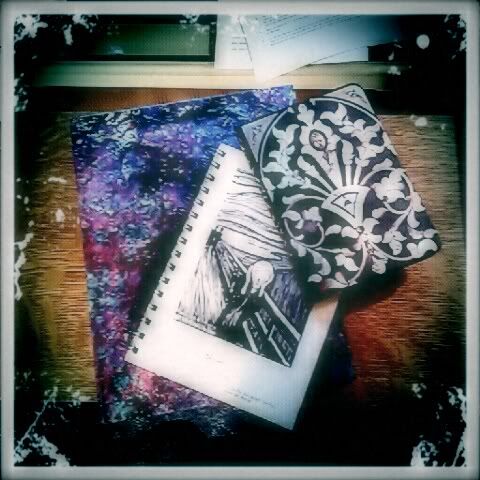
I recommend you have 2 or 3 different journals to refer to in your recovery process. If you so choose, they can be: 1) Journal of Faith, 2) Journal for Managing Emotions, 3) Journal of Wonder & Joy. Obviously, it may be too time consuming to use each one daily, but they can be on hand for you to use whenever you feel the need to focus on a certain aspect in your life. Choose journals with covers that reflect the content you’ll be writing about. For example, my Journal for Managing Emotions has a picture of a painting by Evard Munich, The Scream, and my Journal of Wonder & Joy is a larger size (9 ½ by 11) with a marbleized cover in pastel blues and pinks so that I have enough room to write and paste pictures in.
In this final installment on the healing power of your poetic voice, I want to focus on how to create a Journal of Wonder & Joy. Often, one of the by-products of the abuse experience is an inability to feel or trust the natural sensations we experience as adults. Our senses may, at times, feel threatening because they trigger painful emotional memories of the past. As a defense mechanism we deal with this unfortunate fact by numbing ourselves to ALL our senses, even those that are healthy natural sensations.
To help reclaim the joy of sensation do the following:
1) Either go to or imagine a place that you feel most safe in. It could be a beach, a park, a room in your house, a beloved friend or family member’s home, backyard etc. Using all of your senses describe everything about this place. What sounds do you hear? What do you see, be specific? What smells or tastes do you experience?
2) After you have a very detailed description, use the declarative statement of I love… to describe how you feel about this place and why it gives you joy, makes you feel safe etc.
3) To take it a step further, use your descriptions to write a story about a pleasant memory you had in this place. Allow yourself to really feel the sensations in your body as you describe. If in the process you start to feel shameful or dirty for feeling these things, remind yourself that this is a safe place and the sensations you are feeling are connected to something that you know is healthy and nurturing to the person you are today.
In a similar fashion, use the same process to document the pleasant memories of your past. The truth is that past memories are not all painful. All of us have had at least one or more moments in our lives that bring a smile to our faces when we remember them. The problem is the abuse, being all consuming at times, hasn’t allowed you to fully enjoy those wonderful memories. Reclaim your pleasant memories by applying the steps described above. Imagine and describe all you see, hear, smell, taste and feel about these memories. If you’re a visual person, you may want to include a collage of pictures and words from magazines to illustrate the descriptions you’ve written.
Hopefully, such focused journaling of your experiences will empower you to walk in light, to cultivate healing words, and to know you have a voice to express both the ugly and beautiful truths of your journey beyond abuse.
I saw the cumulative power of this practice recently. I was in the process of organizing a small closet that held all of my old journals. It was a very enlightening project. Reading these journals both horrified and empowered me. I was horrified by the voice of the person who wrote those words. I couldn’t relate to her, she was so different from who I am today. I had a hard time believing that my hand wrote the words I was reading.
But, then I realized I am a 40-something woman reading the words of a 20-something girl who had not yet started on her journey of healing beyond abuse. This girl was fumbling around in darkness without any sense of who she was, but she was writing-her-way to understanding, trying to figure it all out by chronicling her daily life, crying out to God and meditating on scripture. What empowers the woman I am today is the fact that I am no longer that lost girl. In my hand was a testimony to who I was then, but in my heart and head was the knowledge that I have grown beyond her.
Some of the questions she had, I found answers too. Some of the guilt and shame she suffered, I am able to deal with because of the tools I’ve been given to do so. She was lost in darkness and I walk in light. A light that often shines on some ugly realities but, because I am able to see them clearly through my journals, I have the perception to handle them truthfully. That’s not to say I always do so, but I cannot deny that the lies and truths I’ve discovered so far in my journey are in full view because of the light they now live in.
This is the power of journaling. This is the healing power of written testimony!
Thursday, May 20, 2010
Managing Emotions Through Declarative Statements
 The Healing Power of Your Poetic Soul, Part 3
by Kristy Johnson
Emotions are tricky and often unmanageable for abuse survivors. Because of your experiences, you often have a hard time pinpointing what you ACTUALLY feel at any given moment. You bounce back and forth between extremes of feeling numb or drowning in overwhelming feelings of rage, hatred, loneliness depression, etc. At times it’s difficult to answer the simple question, “How are you feeling today?” Answering the “Why” of certain emotions and figuring out where and what your sensations stem from might seem like you’re trying to penetrate a concrete wall.
This wall of locked up emotions may even be more confusing because of your damaged sense of self. You struggle with low self esteem and frequently live with a broken record, whispering in your head, such lies as: I’m not worthy, I’m stupid, I will never amount to anything because of what happened to me, I’m nobody, I’ll never be ‘normal’, Why express myself, no one is really listening to me anyway, I have nothing of value to add to this life…etc.
It is in those moments when emotions and lies are raging and your broken self feels beyond repair that the concept of the poetic soul, frankly, just ain’t gonna cut it!!! At these chaotic times-- before you can even find the strength to create a calm, meditative space for healing words to flow-- you need a tool, more like a weapon, that will help you break through the concrete wall of your damaged and puzzling emotions.
The following exercise can be such a tool to use during these emotionally intense periods:
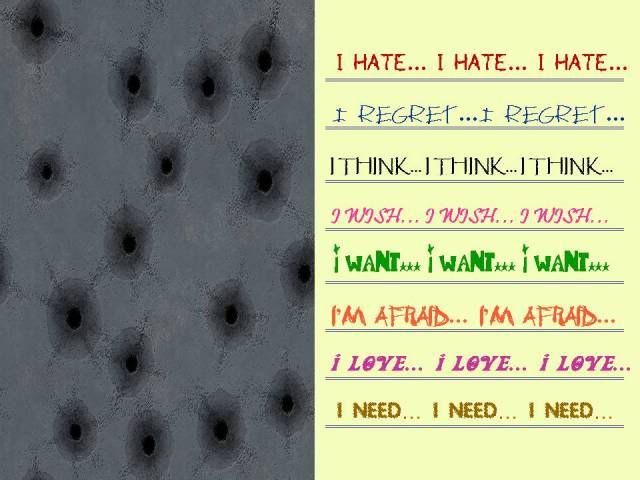
In a journal, notebook or computer write a series of ‘I’ declarative statements. ‘I’ declaratives – are statements that begin with the word ‘I’ and are attached to an open-ended phrase that expresses and describes certain thoughts or emotions. For example: I hate…, I regret…, I think…, I wish…, I want…, I’m afraid…, I love…, I want…, etc.
The exercise works like this--
1. Choose the declarative statement you think will help express what you are feeling in the moment. I’ve found the statement I hate… to be very useful when I’m overwhelmed with feelings of rage and anger (the word hate may seem too strong to use if you come from a Christian tradition, if you feel this is the case, may I suggest you read Sallie Culbreth’s founder’s blog article dated April 22, 2010 --http://sallieculbrethcommittedtofreedom.blogspot.com/2010/04/hatred-forbidden-emotion.html before attempting this particular one).
2. If you are writing in a journal or notebook, pick out one that hasn’t been written in and use it for this exercise only. Have colored pens, pencils, crayons or markers to choose from and use a different color to express each declarative statement. For example: red for HATE or ANGRY, pink for LOVE, purple for WISH, blue for REGRET or SORRY, etc. If you choose to use a computer then pick out different fonts to use that you think will visually reflect each declarative statement. Make sure to have the colors or fonts picked out before you begin writing.
3. Leave a space between each statement, in other words each declarative should be on one line, then double space and write another, etc.
4. Keep in mind before you start-- this exercise is meant to break THROUGH your concrete wall, so each statement should fire out of you like machine gun bullets. There is no time for reflection or thinking with this one. Do your best to turn off that inner critic lurking inside and write down the first thing that comes out! Don’t go back and re-read what you wrote, don’t erase, correct spelling or do any editing of what has already been written. JUST WRITE, WRITE, WRITE!
For example, here is how I am feeling at this moment:
I hate… that I feel inadequate to write this article.
I hate…that it’s raining outside.
I hate…that I’m afraid I won’t meet the deadline.
I hate…that this doesn’t’ read as brilliantly as I want it to.
I hate…my inner critic.
5. You will find, after the first attempt, that other ‘I’ declarative statements will feed off those that came before, so that you’ll want to introduce the new statements (remember to use the corresponding color marker or font for each new statement). This will help with pulling apart the confusing mix of feelings that seemed impossible to declare before the exercise.
Here is another example I did in my own healing process:
I’m afraid…of being me.
I love…being me.
I want…to stay being me.
I want…more than this.
I’m afraid…that after reading what I have so far and taking a nap there is this compulsion to erase it all
I’m afraid…of this ugliness towards my [insert specific person you’re dealing with]
I hate…the time I’ve wasted not dealing with this [insert appropriate explicative, if necessary]
I’m sorry…for having written this and even starting this stupid exercise at all.
6. To start with you may want to give yourself a timeframe, say 15-20 minutes. But, if at the end of the timeframe you still feel like the thoughts and feelings you’re expressing are firing out at full blast then, well, let ‘er rip!!! Remember, this is a tool for you alone, you will not be graded or even have to show anyone what you wrote. The process and rhythm of the exercise is up to you and there is no pressure to do it.
What you find out, as a result of this exercise, may not be pretty, in fact, it may bring out some very ugly, scary and devastating truths that are hard to face. But, what you will have is a map of statements that will help lead you to the truth of the what, why and how of your emotional landscape. Hopefully, this tool will be a significant ally to empower you to bravely and honestly manage your difficult emotions and declare to yourself, and possibly to others, who you truly are today as a survivor journeying beyond your abuse.
Thursday, May 13, 2010
The Healing Power of Your Poetic Soul, Part 2*

Bearing Testimony Through Practical Writing Exercises
by Kristy Johnson
www.committedtofreedom.org
Cultivating a poetic soul and giving voice to the journey beyond abuse through reflective writing may sound like a "high falootin" concept for many of us. There may be plenty of excuses we can come up with to avoid even trying to write about the guideposts or road blocks on this path such as: I'm not a writer, I hate poetry, I'm afraid of addressing my specific issues on paper, I have no time for this or I'm more of a visual person-I like painting, collaging, taking pictures, scrapbooking etc.
I'm not here to teach you how to be a poet, or a writer, necessarily. The following writing exercises can simply be another tool to attempt, to help you confront, celebrate, bear testimony to, and figure out some of the emotions, triggers or behavior patterns that you continue to deal with on your journey. In other words, take it or leave it but give it a try. You may find a new way of looking at the struggles you face and gain a fresh sense of strength to tackle problems that seemed too overwhelming to handle.
I have found, whether it reads well or not, that simply writing out how I feel about a particular trigger, emotion, person or problem on a piece of paper--that I can hold in my hand--makes it feel more manageable. When these things live inside us they can often feel like the Great and Powerful Wizard of Oz, filled with smoke and mirrors looming large and roaring, but by putting them down on paper we are able to reduce them to what they really are----the deceptive lies that have felt like truth, the little man behind the curtain.
Here are a couple of exercises for you to try:
1. Write a "Dear John" letter to an emotion that you struggle with such as: bitterness, rage, depression, fear, self-loathing or shame and treat them as if they are a person you are breaking up with, for example:
Dear Fear: You have been a constant companion, I could always count on you being by my side "protecting" me from any new opportunity, relationship or possible hurt that came my way. I know you thought you saved me from many disasters, but actually you kept me from really living. Fortunately, I've found someone else who is perfect. I can't introduce you because they actually are not able to exist in the same room with you--their name is Love. Good Riddance, [your name]
In doing this it helps to let yourself be very specific about how a certain emotion has affected your life. Find a way to be humorous and down-to-earth in how you address it. List both what may have felt "good" about your experience with it and how it may have harmed your life. Hopefully, this type of exercise will give you a new point of view on how toxic certain emotions have been in your life and allow you to tackle them with a fresh sense of empowerment, so that you start the process of "breaking up" with them.
2. Write an Ode about a trigger, emotion, piece of art, photo, useful tool, or memento that has been meaningful on your journey. An Ode is a poetic form that is simply in praise of, or dedicated to someone or something which captures a person's interest and serves as inspiration. Most of the time it is used to celebrate something but for our purposes it can be used to call out both the positive and negative qualities of what you're writing about. Here's one of my own examples, written on a particular trigger I've struggled with:
Ode to a Spider I flinch when I see you in any form. You make my heart pound, breath stop, palms sweat. Even silly cartoon versions of you give me fright. Dear Charlette in her web causes me to run for cover. Before, I remembered, I let you crawl on my arm, I marveled at your handiwork as you spun beautiful tapestries that glistened in the sun. Then, as a grown-up, I remembered why you're scary. You remind me of hands, creeping in places they don't belong. And you were there, a witness, hanging above my head by a thread. But, the truth is, when I see you it doesn't have to be a reminder of what happened. Could it be that you were weaving your way down to help me? But, being too small all you could do was be a witness. I am learning to appreciate you again. How you leave your mark, how you are able to transform dark, secret places into memorials to what was but that can be brushed away with a strong healing hand.
As you can see from this example, you don't have to know how to rhyme or even use "fancy" wording. Simply take the thing you want to write about and examine it by answering the five basic questions of a journalist-who, what, where, why and how-add to this descriptions using the five senses of sight, hearing, touch, smell and taste. In other words; who is this (who gave it to you), what is it (what happened to cause its influence on you), where did you get it, why is it significant, how can you see it in a different light. Then describe what it looks, sounds, feels, tastes or smells like. Remember, I'm not asking you to write a poem, although it may look like the form of a poem, this is just an exercise.
Hopefully, both exercises will help you take time to really look at the stumbling blocks you struggle with on the journey. I have found such exercises very useful, especially in helping me to find a new perspective about something that seemed a never-ending battle. Though I mostly concentrated on writing about the negative emotions and triggers we face; these exercises can also be used to show gratitude for something that has brought great healing in your life.
Kristy Johnson, MFA, is a poet who lives in New York City - Brooklyn. She works with Committed to Freedom as a retreat facilitator, editor, and creative consultant.
*This is the second in a series of articles to help you learn writing skills to unleash your poetic voice. There will be two more articles to follow in the coming weeks:
* Managing Emotions Through Declarative Statements
* How To Use Words As A Healing Part Of Your Journey - Focused Journal Writing
Thursday, May 6, 2010
The Healing Power of Your Poetic Soul, Part 1
This is the first of a four part series on creative writing and its healing power in your abuse recovery. It is written by New York poet Kristy Johnson, MFA.
No one can see their reflection in running water. It is only in still water that we can see. - Taoist Proverb
Recently, I was on a plane flying from New York city in route to Little Rock, AR. I was on my way to the Committed to Freedom Reconnect Alumni Conference where, besides being a participant, I was going to a workshop on using poetry as a tool to “find your voice”. I find that plane rides can be perfect places to contemplate the poetic in life. Note this typical scene:
There is a bustle of activity in boarding, some passengers are looking for their seats, while others are finding space to store carry-ons, as flight attendants are making announcements over the loud speaker. The sound of clicks from seatbelts being fastened, the murmur of introductions or last minute phone conversations, babies and toddlers crying or cooing, books and laptops being shoved in the backseat pockets, all fill the crowded space.
After everyone is seated and belted into place, passengers are asked to be seated for take off. There is no movement, no phone or computer use allowed, everyone is asked to wait until “The Capitan has turned off the seatbelt sign, then you are free to move about the cabin.” All on flight, including the flight attendants, are at rest, forced to focus, either on the feeling of rising into the air or simply on the lighted seatbelt sign. At that time,the cabin is almost motionless-- a collective moment of forced peace.
Then, at 10,000 feet, there is a ding that sounds, the seat belt light goes off and the flight attendants announce “you are free to move about the cabin.” Suddenly, the flurry begins again, as some make their way to the rest room, open the overhead compartments to get their laptops, books, knitting, etc. and the murmur of conversation begins again.
It is in that “collective moment of forced peace” where poetry lives and is. Poetry lives in the in between points of our lives. It is between the habitual and stress-filled activity of our daily living; between regret, fear and the loss of the past and the anxious possibility of the future. The poetic moments in life are often in the present, they have no past or future - they simply are, right now, in focus and at rest for us to meditate upon.
Those of us raised in the Christian tradition understand this concept. We are told in the scriptures to, “Be still and know that I am God.” It is a call to stop the motion of our active lives and really give attention to understanding and connecting with God. Some Eastern philosophies follow a practice of what they call “calm abiding.” This is defined as, “the one-pointed abiding on any object without distraction of a mind conjoined with a bliss of physical and mental pliancy.” It is an invitation to find peace, insight, stability and wisdom through concentrated focus and perspective on what is true. For us, as survivors, it is a call to transform the lies that feel like truth into the truth that has felt like a lie.
But, walking a focused existence can feel virtually impossible to us, as abuse survivors. Ironically, we understand a negative form of focusing on an event, object or emotion. Because of what has happened to us we often cannot STOP focusing on the terror of our abuse or the emotions, physical ailments, negative self talk, etc. that have resulted from it. Fighting our triggers and emotional allergies is a constant battle.
Cultivating a poetic soul may actually sound like a threat. We want to get away from the moments, memories and thoughts that keep us from functioning and dealing with the daily bustle that demands our attention. How does this apply to me when my boss is pressuring me to meet a deadline, my back is aching from a long day of standing on my feet, my kids are sick or in trouble at school, I’m worried where my next pay check is coming from, etc.? What does cultivating a poetic soul mean with respect to my everyday life?
Understanding how to live in the present and cultivate moments of stillness and focus even in the midst of our raging days can be a valuable tool. We have the power, as survivors, to stop and RE-focus on the how and why abuse is affecting us right now. Being poetic for us means using the tools we have been given to quiet the fearful, anxious, negative voices and images of past memories and transforming them into manageable healing words, images and strategies that will give us the ability to move on. We can live in the freedom of the present because, no matter how awful life may get, we have the strength to declare that we are no longer at the power and control of someone else. Cultivating a poetic soul involves finding practical ways to live in the wonderful fact that WE ARE STILL HERE and giving voice to who we truly are—beautiful, expressive, valued yet wounded sojourners finding our way to healing step by limping step.
Over the next few weeks I would like to introduce some practical exercises for you to use on your journey. Writing and the use of poetic healing words and word pictures can be another tool for us to draw on to: help find our voice, manage the emotions and lies that creep up daily, and discover the resting place that will give us strength, in between our busy lives.
Subscribe to:
Posts (Atom)