Thursday, May 27, 2010

Focused Journal Writing

The Healing Power of Your Poetic Soul, Part 4
Focused Journal Writing

by Kristy Johnson


… if we walk in the light, God himself being the light,
we also experience a shared life with one another…
(1 John 1: 7, The Message)


You may already realize the value of journaling, but in this last part of our four part series on your poetic soul, I want to introduce you to a few variations on how to journal. These variations can be prompts for you to determine how YOU want to proceed. Many people use the practice of journaling to: 1) meditate on scripture, 2) as a devotional to cry out to God, or 3) to keep a list of prayers for others, etc. This, of course, is an important practice in the walk of faith. Journaling can be used, as well, to chronicle and manage the difficult emotions, triggers and pain that you face as a survivor of abuse. And it can ALSO be used to help you reconnect with the JOYS of sensation and reclaim the memories of your past that give you PLEASURE rather than pain. It can help you walk in the light.

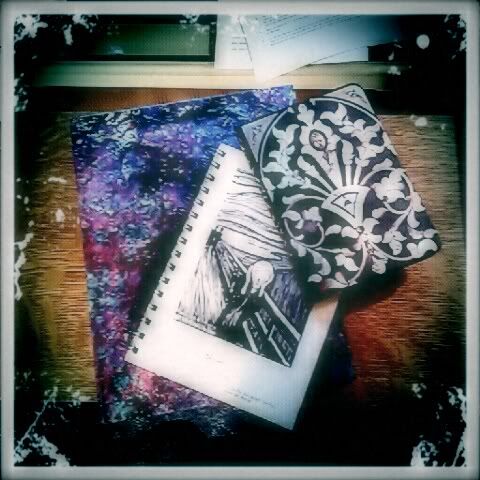
I recommend you have 2 or 3 different journals to refer to in your recovery process. If you so choose, they can be: 1) Journal of Faith, 2) Journal for Managing Emotions, 3) Journal of Wonder & Joy. Obviously, it may be too time consuming to use each one daily, but they can be on hand for you to use whenever you feel the need to focus on a certain aspect in your life. Choose journals with covers that reflect the content you’ll be writing about. For example, my Journal for Managing Emotions has a picture of a painting by Evard Munich, The Scream, and my Journal of Wonder & Joy is a larger size (9 ½ by 11) with a marbleized cover in pastel blues and pinks so that I have enough room to write and paste pictures in.

In this final installment on the healing power of your poetic voice, I want to focus on how to create a Journal of Wonder & Joy. Often, one of the by-products of the abuse experience is an inability to feel or trust the natural sensations we experience as adults. Our senses may, at times, feel threatening because they trigger painful emotional memories of the past. As a defense mechanism we deal with this unfortunate fact by numbing ourselves to ALL our senses, even those that are healthy natural sensations.

To help reclaim the joy of sensation do the following:

1) Either go to or imagine a place that you feel most safe in. It could be a beach, a park, a room in your house, a beloved friend or family member’s home, backyard etc. Using all of your senses describe everything about this place. What sounds do you hear? What do you see, be specific? What smells or tastes do you experience?

2) After you have a very detailed description, use the declarative statement of I love… to describe how you feel about this place and why it gives you joy, makes you feel safe etc.

3) To take it a step further, use your descriptions to write a story about a pleasant memory you had in this place. Allow yourself to really feel the sensations in your body as you describe. If in the process you start to feel shameful or dirty for feeling these things, remind yourself that this is a safe place and the sensations you are feeling are connected to something that you know is healthy and nurturing to the person you are today.

In a similar fashion, use the same process to document the pleasant memories of your past. The truth is that past memories are not all painful. All of us have had at least one or more moments in our lives that bring a smile to our faces when we remember them. The problem is the abuse, being all consuming at times, hasn’t allowed you to fully enjoy those wonderful memories. Reclaim your pleasant memories by applying the steps described above. Imagine and describe all you see, hear, smell, taste and feel about these memories. If you’re a visual person, you may want to include a collage of pictures and words from magazines to illustrate the descriptions you’ve written.

Hopefully, such focused journaling of your experiences will empower you to walk in light, to cultivate healing words, and to know you have a voice to express both the ugly and beautiful truths of your journey beyond abuse.

I saw the cumulative power of this practice recently. I was in the process of organizing a small closet that held all of my old journals. It was a very enlightening project. Reading these journals both horrified and empowered me. I was horrified by the voice of the person who wrote those words. I couldn’t relate to her, she was so different from who I am today. I had a hard time believing that my hand wrote the words I was reading.

But, then I realized I am a 40-something woman reading the words of a 20-something girl who had not yet started on her journey of healing beyond abuse. This girl was fumbling around in darkness without any sense of who she was, but she was writing-her-way to understanding, trying to figure it all out by chronicling her daily life, crying out to God and meditating on scripture. What empowers the woman I am today is the fact that I am no longer that lost girl. In my hand was a testimony to who I was then, but in my heart and head was the knowledge that I have grown beyond her.

Some of the questions she had, I found answers too. Some of the guilt and shame she suffered, I am able to deal with because of the tools I’ve been given to do so. She was lost in darkness and I walk in light. A light that often shines on some ugly realities but, because I am able to see them clearly through my journals, I have the perception to handle them truthfully. That’s not to say I always do so, but I cannot deny that the lies and truths I’ve discovered so far in my journey are in full view because of the light they now live in.

This is the power of journaling. This is the healing power of written testimony!

Thursday, May 20, 2010

Managing Emotions Through Declarative Statements

The Healing Power of Your Poetic Soul, Part 3
by Kristy Johnson

Emotions are tricky and often unmanageable for abuse survivors. Because of your experiences, you often have a hard time pinpointing what you ACTUALLY feel at any given moment. You bounce back and forth between extremes of feeling numb or drowning in overwhelming feelings of rage, hatred, loneliness depression, etc. At times it’s difficult to answer the simple question, “How are you feeling today?” Answering the “Why” of certain emotions and figuring out where and what your sensations stem from might seem like you’re trying to penetrate a concrete wall.

This wall of locked up emotions may even be more confusing because of your damaged sense of self. You struggle with low self esteem and frequently live with a broken record, whispering in your head, such lies as: I’m not worthy, I’m stupid, I will never amount to anything because of what happened to me, I’m nobody, I’ll never be ‘normal’, Why express myself, no one is really listening to me anyway, I have nothing of value to add to this life…etc.

It is in those moments when emotions and lies are raging and your broken self feels beyond repair that the concept of the poetic soul, frankly, just ain’t gonna cut it!!! At these chaotic times-- before you can even find the strength to create a calm, meditative space for healing words to flow-- you need a tool, more like a weapon, that will help you break through the concrete wall of your damaged and puzzling emotions.

The following exercise can be such a tool to use during these emotionally intense periods:

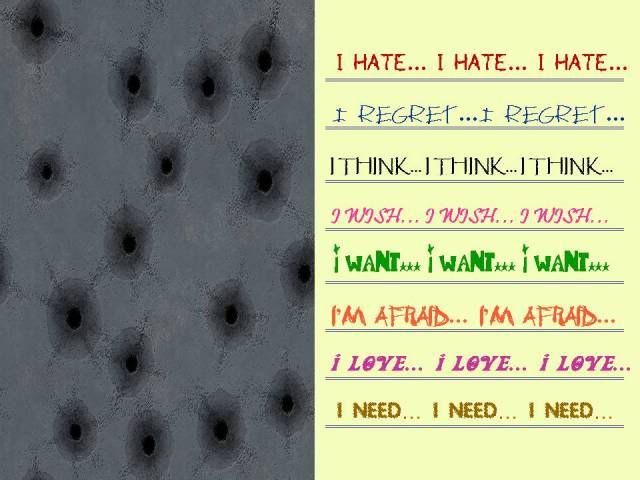
In a journal, notebook or computer write a series of ‘I’ declarative statements. ‘I’ declaratives – are statements that begin with the word ‘I’ and are attached to an open-ended phrase that expresses and describes certain thoughts or emotions. For example: I hate…, I regret…, I think…, I wish…, I want…, I’m afraid…, I love…, I want…, etc.

The exercise works like this--

1. Choose the declarative statement you think will help express what you are feeling in the moment. I’ve found the statement I hate… to be very useful when I’m overwhelmed with feelings of rage and anger (the word hate may seem too strong to use if you come from a Christian tradition, if you feel this is the case, may I suggest you read Sallie Culbreth’s founder’s blog article dated April 22, 2010 --http://sallieculbrethcommittedtofreedom.blogspot.com/2010/04/hatred-forbidden-emotion.html before attempting this particular one).

2. If you are writing in a journal or notebook, pick out one that hasn’t been written in and use it for this exercise only. Have colored pens, pencils, crayons or markers to choose from and use a different color to express each declarative statement. For example: red for HATE or ANGRY, pink for LOVE, purple for WISH, blue for REGRET or SORRY, etc. If you choose to use a computer then pick out different fonts to use that you think will visually reflect each declarative statement. Make sure to have the colors or fonts picked out before you begin writing.

3. Leave a space between each statement, in other words each declarative should be on one line, then double space and write another, etc.

4. Keep in mind before you start-- this exercise is meant to break THROUGH your concrete wall, so each statement should fire out of you like machine gun bullets. There is no time for reflection or thinking with this one. Do your best to turn off that inner critic lurking inside and write down the first thing that comes out! Don’t go back and re-read what you wrote, don’t erase, correct spelling or do any editing of what has already been written. JUST WRITE, WRITE, WRITE!

For example, here is how I am feeling at this moment:
I hate… that I feel inadequate to write this article.
I hate…that it’s raining outside.
I hate…that I’m afraid I won’t meet the deadline.
I hate…that this doesn’t’ read as brilliantly as I want it to.
I hate…my inner critic.

5. You will find, after the first attempt, that other ‘I’ declarative statements will feed off those that came before, so that you’ll want to introduce the new statements (remember to use the corresponding color marker or font for each new statement). This will help with pulling apart the confusing mix of feelings that seemed impossible to declare before the exercise.

Here is another example I did in my own healing process:
I’m afraid…of being me.
I love…being me.
I want…to stay being me.
I want…more than this.
I’m afraid…that after reading what I have so far and taking a nap there is this compulsion to erase it all
I’m afraid…of this ugliness towards my [insert specific person you’re dealing with]
I hate…the time I’ve wasted not dealing with this [insert appropriate explicative, if necessary]
I’m sorry…for having written this and even starting this stupid exercise at all.

6. To start with you may want to give yourself a timeframe, say 15-20 minutes. But, if at the end of the timeframe you still feel like the thoughts and feelings you’re expressing are firing out at full blast then, well, let ‘er rip!!! Remember, this is a tool for you alone, you will not be graded or even have to show anyone what you wrote. The process and rhythm of the exercise is up to you and there is no pressure to do it.

What you find out, as a result of this exercise, may not be pretty, in fact, it may bring out some very ugly, scary and devastating truths that are hard to face. But, what you will have is a map of statements that will help lead you to the truth of the what, why and how of your emotional landscape. Hopefully, this tool will be a significant ally to empower you to bravely and honestly manage your difficult emotions and declare to yourself, and possibly to others, who you truly are today as a survivor journeying beyond your abuse.

Thursday, May 13, 2010

The Healing Power of Your Poetic Soul, Part 2*


Bearing Testimony Through Practical Writing Exercises
by Kristy Johnson
www.committedtofreedom.org

Cultivating a poetic soul and giving voice to the journey beyond abuse through reflective writing may sound like a "high falootin" concept for many of us. There may be plenty of excuses we can come up with to avoid even trying to write about the guideposts or road blocks on this path such as: I'm not a writer, I hate poetry, I'm afraid of addressing my specific issues on paper, I have no time for this or I'm more of a visual person-I like painting, collaging, taking pictures, scrapbooking etc.

I'm not here to teach you how to be a poet, or a writer, necessarily. The following writing exercises can simply be another tool to attempt, to help you confront, celebrate, bear testimony to, and figure out some of the emotions, triggers or behavior patterns that you continue to deal with on your journey. In other words, take it or leave it but give it a try. You may find a new way of looking at the struggles you face and gain a fresh sense of strength to tackle problems that seemed too overwhelming to handle.

I have found, whether it reads well or not, that simply writing out how I feel about a particular trigger, emotion, person or problem on a piece of paper--that I can hold in my hand--makes it feel more manageable. When these things live inside us they can often feel like the Great and Powerful Wizard of Oz, filled with smoke and mirrors looming large and roaring, but by putting them down on paper we are able to reduce them to what they really are----the deceptive lies that have felt like truth, the little man behind the curtain.

Here are a couple of exercises for you to try:

1. Write a "Dear John" letter to an emotion that you struggle with such as: bitterness, rage, depression, fear, self-loathing or shame and treat them as if they are a person you are breaking up with, for example:

Dear Fear: You have been a constant companion, I could always count on you being by my side "protecting" me from any new opportunity, relationship or possible hurt that came my way. I know you thought you saved me from many disasters, but actually you kept me from really living. Fortunately, I've found someone else who is perfect. I can't introduce you because they actually are not able to exist in the same room with you--their name is Love. Good Riddance, [your name]

In doing this it helps to let yourself be very specific about how a certain emotion has affected your life. Find a way to be humorous and down-to-earth in how you address it. List both what may have felt "good" about your experience with it and how it may have harmed your life. Hopefully, this type of exercise will give you a new point of view on how toxic certain emotions have been in your life and allow you to tackle them with a fresh sense of empowerment, so that you start the process of "breaking up" with them.

2. Write an Ode about a trigger, emotion, piece of art, photo, useful tool, or memento that has been meaningful on your journey. An Ode is a poetic form that is simply in praise of, or dedicated to someone or something which captures a person's interest and serves as inspiration. Most of the time it is used to celebrate something but for our purposes it can be used to call out both the positive and negative qualities of what you're writing about. Here's one of my own examples, written on a particular trigger I've struggled with:

Ode to a Spider I flinch when I see you in any form. You make my heart pound, breath stop, palms sweat. Even silly cartoon versions of you give me fright. Dear Charlette in her web causes me to run for cover. Before, I remembered, I let you crawl on my arm, I marveled at your handiwork as you spun beautiful tapestries that glistened in the sun. Then, as a grown-up, I remembered why you're scary. You remind me of hands, creeping in places they don't belong. And you were there, a witness, hanging above my head by a thread. But, the truth is, when I see you it doesn't have to be a reminder of what happened. Could it be that you were weaving your way down to help me? But, being too small all you could do was be a witness. I am learning to appreciate you again. How you leave your mark, how you are able to transform dark, secret places into memorials to what was but that can be brushed away with a strong healing hand.

As you can see from this example, you don't have to know how to rhyme or even use "fancy" wording. Simply take the thing you want to write about and examine it by answering the five basic questions of a journalist-who, what, where, why and how-add to this descriptions using the five senses of sight, hearing, touch, smell and taste. In other words; who is this (who gave it to you), what is it (what happened to cause its influence on you), where did you get it, why is it significant, how can you see it in a different light. Then describe what it looks, sounds, feels, tastes or smells like. Remember, I'm not asking you to write a poem, although it may look like the form of a poem, this is just an exercise.

Hopefully, both exercises will help you take time to really look at the stumbling blocks you struggle with on the journey. I have found such exercises very useful, especially in helping me to find a new perspective about something that seemed a never-ending battle. Though I mostly concentrated on writing about the negative emotions and triggers we face; these exercises can also be used to show gratitude for something that has brought great healing in your life.


Kristy Johnson, MFA, is a poet who lives in New York City - Brooklyn. She works with Committed to Freedom as a retreat facilitator, editor, and creative consultant.

*This is the second in a series of articles to help you learn writing skills to unleash your poetic voice. There will be two more articles to follow in the coming weeks:

* Managing Emotions Through Declarative Statements
* How To Use Words As A Healing Part Of Your Journey - Focused Journal Writing

Thursday, May 6, 2010

The Healing Power of Your Poetic Soul, Part 1


This is the first of a four part series on creative writing and its healing power in your abuse recovery. It is written by New York poet Kristy Johnson, MFA.

No one can see their reflection in running water. It is only in still water that we can see. - Taoist Proverb

Recently, I was on a plane flying from New York city in route to Little Rock, AR. I was on my way to the Committed to Freedom Reconnect Alumni Conference where, besides being a participant, I was going to a workshop on using poetry as a tool to “find your voice”. I find that plane rides can be perfect places to contemplate the poetic in life. Note this typical scene:

There is a bustle of activity in boarding, some passengers are looking for their seats, while others are finding space to store carry-ons, as flight attendants are making announcements over the loud speaker. The sound of clicks from seatbelts being fastened, the murmur of introductions or last minute phone conversations, babies and toddlers crying or cooing, books and laptops being shoved in the backseat pockets, all fill the crowded space.

After everyone is seated and belted into place, passengers are asked to be seated for take off. There is no movement, no phone or computer use allowed, everyone is asked to wait until “The Capitan has turned off the seatbelt sign, then you are free to move about the cabin.” All on flight, including the flight attendants, are at rest, forced to focus, either on the feeling of rising into the air or simply on the lighted seatbelt sign. At that time,the cabin is almost motionless-- a collective moment of forced peace.

Then, at 10,000 feet, there is a ding that sounds, the seat belt light goes off and the flight attendants announce “you are free to move about the cabin.” Suddenly, the flurry begins again, as some make their way to the rest room, open the overhead compartments to get their laptops, books, knitting, etc. and the murmur of conversation begins again.

It is in that “collective moment of forced peace” where poetry lives and is. Poetry lives in the in between points of our lives. It is between the habitual and stress-filled activity of our daily living; between regret, fear and the loss of the past and the anxious possibility of the future. The poetic moments in life are often in the present, they have no past or future - they simply are, right now, in focus and at rest for us to meditate upon.

Those of us raised in the Christian tradition understand this concept. We are told in the scriptures to, “Be still and know that I am God.” It is a call to stop the motion of our active lives and really give attention to understanding and connecting with God. Some Eastern philosophies follow a practice of what they call “calm abiding.” This is defined as, “the one-pointed abiding on any object without distraction of a mind conjoined with a bliss of physical and mental pliancy.” It is an invitation to find peace, insight, stability and wisdom through concentrated focus and perspective on what is true. For us, as survivors, it is a call to transform the lies that feel like truth into the truth that has felt like a lie.
But, walking a focused existence can feel virtually impossible to us, as abuse survivors. Ironically, we understand a negative form of focusing on an event, object or emotion. Because of what has happened to us we often cannot STOP focusing on the terror of our abuse or the emotions, physical ailments, negative self talk, etc. that have resulted from it. Fighting our triggers and emotional allergies is a constant battle.

Cultivating a poetic soul may actually sound like a threat. We want to get away from the moments, memories and thoughts that keep us from functioning and dealing with the daily bustle that demands our attention. How does this apply to me when my boss is pressuring me to meet a deadline, my back is aching from a long day of standing on my feet, my kids are sick or in trouble at school, I’m worried where my next pay check is coming from, etc.? What does cultivating a poetic soul mean with respect to my everyday life?

Understanding how to live in the present and cultivate moments of stillness and focus even in the midst of our raging days can be a valuable tool. We have the power, as survivors, to stop and RE-focus on the how and why abuse is affecting us right now. Being poetic for us means using the tools we have been given to quiet the fearful, anxious, negative voices and images of past memories and transforming them into manageable healing words, images and strategies that will give us the ability to move on. We can live in the freedom of the present because, no matter how awful life may get, we have the strength to declare that we are no longer at the power and control of someone else. Cultivating a poetic soul involves finding practical ways to live in the wonderful fact that WE ARE STILL HERE and giving voice to who we truly are—beautiful, expressive, valued yet wounded sojourners finding our way to healing step by limping step.

Over the next few weeks I would like to introduce some practical exercises for you to use on your journey. Writing and the use of poetic healing words and word pictures can be another tool for us to draw on to: help find our voice, manage the emotions and lies that creep up daily, and discover the resting place that will give us strength, in between our busy lives.

Thursday, April 29, 2010

Why It's the Same Person Over and Over

Did you ever wonder why your relationships seem to end up the same way again and again? Why is it that the names and faces change - but it's really the same person packaged differently? Why do you draw people to you that always treat you the same way - no matter how good or bad things start out? Why are you drawn to those people?

A lot of it has to do with poor self-image. The vast majority of abuse survivors think poorly of themselves. They think they have no value, that they're disposable, dirty, and deserving of mistreatment. Those are just a few of the lies that feel like truth - pressed deeply into your heart and mind by your abusers and the circumstances that surrounded the abuse. It was during your early developmental years that you discovered relationships are terrifying, and that is a lesson deeply ingrained in your psyche. As you moved from being a child into an adult, you most likely were unable to successfully make the role transition from dependent child to equal adult with your parents or caregivers.

Poor self-image cripples your autonomy and individuality, leaving you to expend a great deal of energy to hide that fact. Even if you exude confidence to the world, there's still a voice screaming inside "I don't belong . . . I can't do better than this . . . I'm damaged goods that have little value." These lies are where poor self-image comes from and it is an active ingredient in how you relate to other people - how you find them and they find you. How you treat them and how they treat you.

Poor self-image creates anxiety and uncertainty about how you see yourself. It is based on what YOU think that OTHERS think of YOU. If you could somehow broadcast the underpinning of your thinking as you walk down the street or sit in a restaurant or ride on the subway it would sound something like this: "He thinks I'm fat and ugly . . . she thinks I'm a threat . . . they think I shouldn't be here . . . if I just adjust this, they'll notice . . . if I say this, they won't like me . . ." and on and on it goes. It's very noisy inside your head as you go about the task of day-to-day living. So your first filter through which you see and are seen is your self-image and what you think others are thinking of you.

When you are in relationships, you have high hopes about what you can expect from them - but you also have great fear. In fact, that fear is so huge that you already expect disappointment and distrust. When you seek out relationships, you seek people that "seem" to fit your high hopes, but you do so with blinders AND with your OWN defensive cover-up in motion. This is because you seek people who will corroborate your fears of disappointment or mistrust - they will eventually confirm what you think about YOURSELF!

After a relationship wears on, the disguises dissolve and you are both left with frustration, disappointment, anger, and the realization that the OTHER is not as strong or kind or wonderful as you had hoped. This is because poor self-image prevents you from being honest in the EARLY stages of a relationship. You cannot and will not risk exposing your beliefs about yourself - your beliefs that you are NOTHING. Another variation on this same disguise is that you believe YOU are the one who can make your partner believe he/she IS something. This eventually drives your relationships into a perpetual guessing game.

With poor self-image, it is difficult to communicate because your ability to negotiate is minimal. At first, because of the insecurity and dishonesty, you develop relationships in which you believe you should be fused together, rather than function as independent individuals. You enter relationships to GET - to find qualities in others that you lack OR find qualities that are actually an extension of yourself and your self-image.

Your relationships quickly dissolve into power struggles - with a winner and a looser, rather than a partnership of individuals who respect each other's strengths and are sensitive to each other's weaknesses. Your relationship may most often be characterized by the "it's me OR you!" mentality - which is extremely dysfunctional and immature. Functional and maturing relationships are most often characterized by the "it's me AND you!" foundation of equal partnership with ample give-and-take as its bedrock.


The poor self-image disguise can cause you to communicate in a covert way. The more covert the communications, the more dysfunctional the relationship is. When unacknowledged, ignored problems are finally exposed, then the myth of happily-ever-after explodes.

At the core of how you draw or are drawn to people is a self-image built around false beliefs, desperately wondering if you are loved or wanted. As long as your facade is firmly in place, your communications will remain covert, you will live your life based on what you think others think about you, and your expectations will be a toxic mixture of unrealistic expectations and paralyzing fear.


Good relationships - functional relationships - are built on YOU loving yourself, first. No one is going to love you enough to make you feel good about yourself. No one is going to give you all that you need to make the past okay. If you think poorly of yourself - because the lies feels like the truth - then the most perfect child, partner, friend or colleague will never be able to convince you that you're wanted. You will place expectations on them that no one can fill and will set out to prove that they can and will fail you.

Your healing journey can expose lies which will be replaced by truth - truth that you have value, that you deserve respect and dignity, and that you can form collaborative, mature partnerships with people. As those truths occupy more and more of your interior thoughts and exterior actions, you will discover you have the ability to embrace functional relationships. You'll not be afraid to have personal boundaries. You'll not be a score keeper. You'll not discard yourself or others. You'll not lose yourself trying to fill a need that no mere mortal can completely fill - and subsequently - you'll be drawn to others who confirm your beliefs and respect you.

Thursday, April 22, 2010

Hatred - The Forbidden Emotion


Often times, Christian people use denial as a kind of pseudo-faith. If you pretend it's not there, then you can pretend you've released it to God or that it is no longer an issue for you. Of course, we all know that denial is a cheap substitute for faith. It's a cheap substitute for the enduring impact that is possible when the hard issues are faced head-on. There are many reasons we practice the pseudo-faith of denial. One of the primary reasons is "I shouldn't be . . ." thinking.

"I shouldn't be thinking this . . . I shouldn't be feeling this . . . I shouldn't be wanting this."

Of course, whether you should or shouldn't - if you are, YOU ARE! If you pretend something isn't there, when it is - you're going to spend much more of your energy suppressing that reality than if you actually DEAL with that reality!

That being said, I want to address the emotion of HATE. Yes, yes . . . I know good Christians don't hate, but the truth is, many of us do. I'm going to be very transparent here in hopes that it will help you to honestly evaluate your own feelings. Here's the shocking truth: There are people that I struggle to not hate. Not dislike . . . not irritated by . . . not annoyed with . . . HATE! Here's another shocking truth: There are also experiences and circumstances in my life that I hate. There! I said it out-loud and if truth-be-told, you could probably say the same things.

Hatred - particularly for people of faith - is a forbidden emotion, unless - of course - you're talking about hatred of sin or hatred of evil. Those are acceptable forms of hatred in Christianity (and often used as justification to act hatefully toward those we feel embody sin or evil). I'm not talking about those kinds of hatred that we hold up as "acceptable hatred." I'm talking about down-and-dirty hatred of fellow beings or certain experiences.

Hatred can hit you like a ton of bricks - knocking you over all-at-once. It can also hit you in waves with an ebb and flow of intensity - that knock you over, give you a chance to stand back up, and then knock you over again. Whether the bricks or the waves, hatred has a way of being an energy vampire that drains the very life right out of your soul.

Hatred that is sustained for years is most certainly a poison to every part of you now and in the future. We see that reality played out on the news every day as centuries-old hatreds keep very ancient wounds fresh and raw. I know I'm not telling you anything new when I point out that sustained hatred has a way of escalating until it erupts to destroy you - and not just you - but oftentimes, innocent bystanders, too.

The ebb and flow hatred is a sneaky kind of hatred. You feel it intensely - the ton-of-bricks kind of intensity, and then is fades into the background for awhile. Life goes on and you don't experience it as keenly and then WHAM! Something happens and the quiet "ebb" side of the cycle is replaced by the tidal wave "flow" of the cycle and you're thrown off, once more.

I'm a strong believer in process. Honestly - at least for me - most of my life changes have not come in moments of flash epiphanies, but in the gradual shifts of how I think, how I feel, and how I live. I think the same thing is true with the intense and forbidden emotion of hatred. Bricks or waves - it takes awhile to regain balance when you feel hatred. Hatred is usually complicated. It is mixed in there with injustice, betrayal, violation, trauma, and very real damage - being or having been perpetrated on you or someone/something you love. It takes time to pull these complicated strands apart and examine each one to find a place of balance, of peace, and yes, even forgiveness.

In this process of dealing with hatred, it might be helpful for you to consider these steps:

Acknowledge the hate that you feel - both to yourself and to God
Determine how much these feelings of hatred are causing harm to you or to others
Assess how much energy is being diverted to hate rather than to living above or beyond this person or situation
Consider releasing yourself from the penalty of this harm and damage (this is called forgiveness)
Strategically plan for the next time a wave of hatred knocks you over - so that you won't be caught off-guard or thrown off-course

I'll close with a conversation between me and God that I had recently. I have changed the names and the circumstances (because frankly they're nobody's business!), but hope this gives you a glimpse into how I process hate.

"Dear God, I just want you to know that I hate JSD with every fiber of my being. I'd like to see him suffer and die and rot in hell. Just thought I'd share."

"Hey, Sallie! I just want you to know that I understand your feelings. I've experienced that same kinds of injustice and cruelty that JSD inflicted on you and those you love."

"Dear God! I know you know . . . but I have to tell you that I don't want to NOT feel hate! I WANT to hate. I don't want to forgive. I don't want to be a gentle person of peace. I want to drop a nuclear bomb on JSD."


"Sallie, Again, I know the intensity of your feelings and know why . . . but I'd like to point out that if you hold on to this intensity for long, you'll become just like JSD."

"Dear God, Yes, I know . . . but it just seems so outrageous to FEEL anything but hate for JSD! How am I supposed to feel?"


"Sallie, You're supposed to feel like you feel. The problem isn't that you feel hate, it's that hate will eventually take over and you'll be completely powerless. You are giving ownership of your emotional and spiritual life to JSD and to hatred . . . and I'm pretty sure that's not what you intend to accomplish, right?"

"Dear God, NO! NO! Absolutely NO! I don't want JSD to have any piece of my emotions or spirit!"


"Sallie, Okay . . . so now you know what you don't want . . . which means you can release the parts of this that you have no control over . . . and gain balance and clarity so that you and I can determine what is the best and most productive way forward."

"Dear God, Could we start to work on that, please?"


"Sallie, We are . . ."

Hatred is a terrible task master. It's also a tenacious task master that will require all the honesty, strength, and clarity that your soul can find. It does no good to pretend it isn't there when it is. I also does no good to let it rob you of empowerment and personal peace. Unacknowledged hate will consume you and turn you into a bitter, mean, small creature that may eventually resemble the object of your hatred more than the beauty of your Christ-reflective soul.

Thursday, April 8, 2010

Absolutes


When you see life in terms of absolutes, it's easy to experience your world as being narrow and small. Simple and exclusive. Now don't get me wrong. I think there are many things that are absolute and must be absolutely complied with. Gravity is absolute and if I don't work within the constraints of that absolute, I'll fall off of a building. However, within that absolute is the possibility to harness it, work with it through the laws of physics, and temporarily postpone the "must come down" side of the "what goes up" proverb (What goes up - must come down). We can fly - but only with our machines and our understanding of how to suspend falling - or how to control it.

Abuse survivors are - more often than not - people who thrive on absolutes. Life is black and white. Things are right or wrong. In fact, most of us live as if life is just one giant binary code - yes or no. On or off. Zero or one. It's easier that way. It gives you a sense of having control and staying within range of what is comfortable for you. The problem is that this absolute way of thinking and being can turn you into a rigid person who is incapable of growth and incapable of fully participating in the richness of life.

Don’t get me wrong. I think it is VERY important to know what your personal standards are, to hold firmly to your faith, and to be clear about your values. At the same time, you must develop the ability to hear others, to consider different perspectives, and to respectfully engage in ideas that challenge you. Abuse creates a distortion of ideas and perspectives. It fortifies the damage by pummeling you with false shame, a false sense of responsibility for what happened, and a distorted interpretation of what happened to your body. One thing that keeps wrong thinking firmly intact is rigid absolutes.

You might see people as all bad or all good. You might also think of yourself as either hideous or glorious. Perhaps you smother everyone you know or you push them away. These are the kinds of absolutes that prevent your movement beyond abuse. You interpret the actions of others as being a direct threat or challenge if there's disagreement or difference. You carry the weight of the world on your own shoulders because you're certain no one else can do it. You think everyone is out to get you or that everything is a threat.

Growth takes place when you discover the world is larger than your absolutes. Only when you begin to challenge these absolutes - many of them based on the lies from abuse - will your unclenched fist flower into an open palm, ready to receive the truth of who God made you to be and the freedom to live without being bound by binary thinking. Even if you never waiver from your beliefs or your practices, to live those beliefs out in a world that you understand to be different from you is a huge mark of maturity, particularly for an abuse survivor.

Abuse restricts a survivor’s view of self and others. Growth beyond abuse enlarges that vista so that the color grey is recognized between black and white, the word "maybe" is an option between yes and no, and that right is sometimes wrong, as the apostle Paul observed when he wrote, "Everything is permissible - but not everything is beneficial. Everything is permissible - but not everything is constructive." (1 Corinthians 10:23). Growth beyond abuse is possible with absolutes are replaced with firm convictions, when personal empowerment is dependent on how you think of yourself, not what others think of you, and when you celebrate diversity without compromising your personal integrity.